Friday, June 29, 2007

The commuter drives alone

on the ANC6a e-list we've been discussing how this week, on Constitution Avenue NE, the one way traffic system during the morning commute westward into the city from 7 am to 9:30 am has been rescinded, and now the road is two-way 24/7.

I have been meaning to write about this change for awhile, but I never got around to it. It's another of those pro-community changes initiated by the DC Department of Transportation that in its way is as groundbreaking as the streetscape improvements coming to various neighborhoods and already present on 8th Street SE (it's coming to 12th Street NE in Brookland and H Street NE and presumably other places that I don't know about yet) and the recovery of Thomas Circle from a road scarred circle to something that can become a nice place.

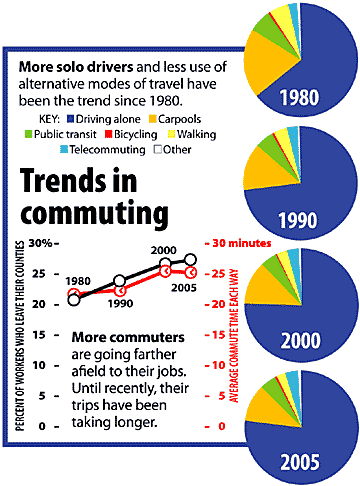
On Monday, the Christian Science Monitor had a nice story about national trends in commuting behavior, "More US commuters drive solo: Global-warming warnings have not dissuaded Americans from driving to work alone. In fact, their numbers have been rising."
Trends in Commuting
Christian Science Monitor. Sources: Figures from 1980 to 2000 are from the Census Bureau. The 2005 figures are based on a survey conducted by the Census Bureau called the American Community Survey / Rich Clabaugh – staff

So while we are doing good things in DC, the trends don't favor the nation.

Labels: , ,

The TDM Professional blog

(Transportation Demand Management) is a resource I've just come across. Produced in part by our friends in Arlington County's transportation programs office, the blog is for:

sharing insight between TDM professionals in the Association for Commuter Transportation (ACT) Chesapeake Chapter (Virginia, Maryland and the District of Columbia)

but open to the rest of us for reading and reflection.

Labels: ,

Thursday, June 07, 2007

Does below ground = heavy rail?

----
Reprinted from Rebuilding Place in the Urban Space
----
Light Rail in Barcelona
Trail plus light rail in Barcelona. Photo by John Norquist.

There are a couple reasons why current transit proposals in the region are for the most part not heavy rail, and above-ground. (1) Heavy rail costs 10 times more to construct than light rail. (2) Tunneling is exorbitant -- $400 million per mile. (3) The Federal Government is promoting bus rapid transit over heavy rail because of (1) and (2)--and because Republican administrations tend to hate heavy rail transit and public transit generally.

(Note that while people talk about how places like Curitiba, Bogota, and Santiago have great ridership numbers with bus rapid transit systems--ridership numbers that compete with heavy rail numbers, the reality is that the riders tolerate much higher bus utilization densities that are tolerated in the U.S. Twice as many riders ride a 60 foot long articulated bus in Santiago or Bogota, as many as 160 people, compared to a similar bus in the U.S. Plus, people who are poorer need the transit. In the U.S., people with mobility choices are less likely to tolerate such conditions. Note that I don't know why bus fares can be so much cheaper in South America.)
X2 bus on H Street NE
60 foot long articulated bus on H Street NE. Photo by Elise Bernard. Actually this route is the #4 bus line in the city in terms of ridership, with a ridership 40% greater than any Metrobus in Maryland or Virginia.

Plus the local jurisdictions, other than the Dulles Corridor project, don't necessarily have the money to move heavy rail forward.

That's why DC totally chickened out over the proposed separated blue line proposal, even though the reality is that DC's continued economic competitiveness and competitive advantage is based upon strengthening mobility in the core of the city.
Proposed changes for the WMATA system, 2001
Proposed separated blue line subway in DC, 2001. Washington Post graphic.

Washcycle calls our attention to an article from WTOP on this issue, "Will Purple Line be Above or Below Ground?" Two good quotes, from Royce Hanson of the Montgomery County Planning Board, and Governor O'Malley. From the article:

As studies ramp up on the proposed Purple Line, which would connect Bethesda to New Carrollton, transportation officials seem to be looking much more toward the below ground option.

Royce Hanson, chairman of the Montgomery County Planning Board, talked to the Maryland Transportation Authority about it.

"Right now they are doing an alignment study, looking at where the line should go exactly and determining how much of it should be a tunnel or on the surface. And, they are placing a lot more emphasis on tunneling than they had in the past," he says.

Maryland Gov. Martin O'Malley would seem to agree with that assessment. He recently gave a speech to transportation officials asking, "Could you imagine if people 30 or 40 years ago had said, 'We want to build a Metro system, but it all has to be above ground and it can only be fast bus.' What kind of region would we have?"
Crowds on the subway, Washington, DC
Metro Center subway station. AFP photo by Karen Bleier.

Washcycle's blog entry on ill-considered writing-thinking against the Purple Line is pretty good too. See "Purple Line: Too Close for Comfort?"

It's a tough issue. I don't know the area that the proposed Purple Line would travel well enough to figure out light rail vs. heavy rail. I don't think the potential ridership is there for the expense of heavy rail. OTOH, heavy rail, because it's much faster would have higher ridership. However, the long term value comes from intensification of land use along the rail corridor. And it makes sense to have one heavy rail system rather than a plethora of heavy and light rail systems.

For a Maryland example, compare the use of land and heavy intensification around the Prince George's Plaza Metro station versus the intersection of New Hampshire Avenue and University Boulevard. Note that the PG Plaza area was intensely developed in comparison decades before the Metro was on the scene, which was written up in the current special supplement "On Site" to the Washington Business Journal.
107068239_96ec533ffe_o
Trans-Milenio photo from Flickr photographer adimcm. This is also a 60' bus. The photo page has an interesting write-up including a link to a conference about BRT.

Labels:

Friday, April 27, 2007

I don't even know where to begin (DC's lack of an integrated land use and transportation policy)

I testified a few times last year against approving the Comprehensive Plan revision, not because it was terrible--for the most part it is not--but because transportation and land use policies were not substantively integrated. (Reading the Comp Plan recently, there are more than 100 policies and actions related to transportation and land use, yet there are only three suggested changes to zoning regulations. And they aren't that substantive.)

I argued that urban design should have been defined as the primary element--meaning that land use policies should have favored compact, walkable places, and that transportation demand management, both as a general policy, as well as a package of services, designed to maximize the use of the transportation infrastructure and to minimize the number of single occupancy vehicle trips, should have been the primary organizing principle for the Transportation Element.

I got heat from some people in the Smart Growth arena -- "don't let the perfect be the enemy of the good."

And at one hearing, I went up to a person who testified in favor of the Comp Plan because it _mentioned_ TDM (at that point the Comp Plan draft didn't even require TDM for planned unit developments, something that changed as a result of my testimony -- I joke that I changed one word in the comp plan, from "suggested" to "required" but only for PUDs, which affect only a small portion of new development). She has 10x more experience in transportation than myself btw. I said how can you testify in favor of the comp plan because it mentions TDM when it is only a mention with no substantive requirements? She didn't have a good response...

One of the points I made in this blog entry "Transit without borders or five omissions "in" the Transportation Element of the DC "Comprehensive" Plan" was about TDM:

-------------------------
Why doesn't the Transportation Element require transportation demand management as a matter of course, for all uses other than that of single-family housing, instead of only suggesting it be required for planned unit developments? (* Note that I would change this now. Parking and curbside management requirements would also impact single family housing.)

This makes no sense. Institutions including schools and churches should be required to develop plans that reduce car trips in a substantive way.

Support for bicyclists and pedestrians should be required. (* Support for bicycling is one of the three zoning changes called for in the Implementation section.)

Parking subsidies should be, for the most part, forbidden, or at the very least matched by comparable subsidies to transit riders. (* Now I would also argue more closely about the need to reduce or eliminate parking requirements for new construction Downtown and in transit corridors and within one half mile of subway stations.)

Multiunit developments should be discouraged from promoting car usage, especially when located to convenient transit.

Incentives should be provided for car sharing. (* And should be required for multiunit housing buildings of a certain size. Plus Downtown, office buildings should have to open up parking at night to the public. Plus they need to participate in TDM planning. I didn't write then either about the creation of "Transportation Management Districts.")

Instead of just focusing on creating "truck routes" through the city, figure out how to time-shift as many commercial deliveries as possible to evening hours because for the most part, roads downtown, and in the northeast and southeast quadrants are underutilized. This would have to be balanced with the desire to not negatively impact neighborhoods. (* Delivery services should also be encouraged as part of BID services and by multi-store shopping facilities and by grocery stores.)

Certain businesses, such as the Au Bon Pain restaurant chain and the Yes! Grocery Stores get the bulk of their deliveries at night, significantly reducing the impact deliveries would otherwise impose on a somewhat stressed road network.

This practice needs to be more widespread and should be spearheaded through TDM requirements (not guidelines, not suggestions) in the Transportation Element.
-------------------------------------

More recently I have written that District Government agencies should be required to conduct TDM. Partly this was a response to proposals for special street parking privileges for firefighters. See "Council ponders reserved parking for firefighters" and "Signs at the Hine School polling site."

Another example of why there should be TDM planning requirements for building uses as well as "accessibility planning" as part of DC land use regulations (zoning) comes from yesterday's Post, with the announcement that the DC Government is going to move the Police Department headquarters to 225 New Jersey Avenue, a building about 6 blocks from the Capitol South subway station, if you walk under the freeway (and somewhat further away from the Navy Yard Green Line and the Federal Center subway stations), and miles away from any other District Government building. See "Police HQ And 1,100 Workers Going to SE."

Accessibility planning does three things:

1. Sites are rated by their access to transportation infrastructure (roads and transit).
2. Uses are rated by their demand for transportation infrastructure (how many trips are generated).
3. Uses can be placed only where transportation demand and transportation supply are at equilibrium, with a bias towards mode shift from single occupancy vehicle trips.

But the accessibility planning paradigm isn't part of the Comprehensive Plan.

From a Transportation Demand Management perspective, it is a disaster to move the Police Department from a central location served by transit and in close proximity to other government buildings housing functions that are "consumed" by Police Department employees during the course of their work day.

1. The current building is within 200 feet of one red line subway station and pretty close to a green-yellow line subway station.
2. Police Department employees frequently must spend time in Court, located immediately next door
3. And meeting with attorneys from either the Federal or City offices, those offices are located close to the current location of the Police Department as well.
4. Plus the building is located across the street from one of the main DC government buildings, as well as being just a few blocks from City Hall.
5. Not to mention the location of some retail services, places for lunch and coffee.

The advantage of agglomeration--the competitive advantage of a "Central Business District" including both commerce and government functions--is that a variety of services and functions are available in a reasonably compact and central fashion.

From the perspective of transportation, this means that most work day business-to-business trips can be conducted on foot or on transit, not via car.

In the new location, Police Department employees will now drive most everywhere, because most of the business and personal trips they will need to make are not satisfiable on site or in close proximity.

Accessibility planning--linking use to its ability to be satisfied by extant transportation infrastructure--should be one of the primary elements of the Zoning Regulations and Land Use Planning. It should trump matter of right.

Currently, matter of right provisions such as allowing schools or churches or police functions to locate anywhere within allowed zones fail to take into account that some locations are much better positioned than others to accommodate the transportation demand produced by the use.

Most new charter schools generate tremendous numbers of car trips every day. Most churches do not provide alternative transportation options other than driving--and they prefer to tear down houses in favor of parking lots, rather than work with communities to figure out ways to accommodate their large but very short term requirements. E.g., tearing down houses to make parking lots that are used only 3 hours of 168 hours in a week is practically the definition of insanity. And locating the Police Department far away from other government offices, far away from transit, and far away from services means that most workers will not have alternative transportation options other than driving.

Government is supposed to drive best practices forward by implementing and practicing best practices. Government is supposed to be a proponent of what is called "rational planning."

Plans to move the Police Department headquarters, and similar proposals and actions to move other DC Government (and related, such as WMATA) functions out of the Central Business District, are a major step backward in local land use and transportation planning, and in the efficient provision and consumption of government services.

Labels: , , , ,

Wednesday, April 25, 2007

Speaking of transit in Washington

A colleague sent me a link to this paper from Resources for the Future, "Transit in Washington, D.C. : Current Benefits and Optimal Level of Provision."

Labels:

Thursday, April 19, 2007

Congestion Survey

(This is a survey by one of my classmates. If you're interested in taking it, send the survey results to Josh Crunkleton.)

Congestion Survey

We’ve all heard the horror stories relating to traffic congestion – people missing once-in-a-lifetime events or an important business meeting to advance their career as a result of a traffic jam. While we all hope to never be involved in any similar scenario, traffic congestion is, without a doubt, a severe problem in many areas.

The following survey aims to acquire public opinion on a variety of traffic-related issues in hopes of addressing traffic congestion woes from a fresh angle – directly from the individuals who experience traffic congestion on a daily basis. The survey should take approximately 10 minutes to complete and asks about your most important daily trip, transit availability and opinions on congestion issues.

Think about a trip you most often take from home, whether it is to work, school, shopping areas or otherwise. With that in mind, please answer the following questions:

What is your most significant recurring destination (i.e. your most important daily trip)?
□ Workplace □ School □ Store/shopping area

□ Other, please describe: _________________________________

What is the approximate distance (in miles) from your household to your most significant recurring destination? ___________
How much would you estimate that a single trip to your most significant recurring destination costs? ___________($/trip)
Please list the 3 most important aspects of this cost estimate:

_________________________________

_________________________________

_________________________________

In general, what is your average time spent (in minutes) traveling on a typical day to or from this destination (whichever is greater)? __________

Estimate the amount of delay (in minutes) that you experience on a typical day due to congestion on this trip: __________

Please continue to think about your most significant daily trip.

If dense traffic congestion were to cause a 30-minute delay on your route, how much would you have to be paid (by transportation agencies, etc.) in order to accept the delay? __________($)

If you could consistently decrease the travel time of your most important daily trip by 25%, how much would you be willing to pay, per trip? __________($)

Leaders in Maryland and Virginia seem to be satisfied with the idea of utilizing congestion pricing (i.e. high-occupancy toll, or HOT, lanes) on newly constructed driving lanes. Conversely, how do you feel about the possibility of accepting tolls in pre-existing lanes, if it potentially means that you could avoid certain congestion levels? Other lanes on the same roadway would remain un-tolled, while the option exists to utilize the congestion-free toll lanes.
□ No interest □ Low interest □ Medium interest □ High interest

The following questions relate to the availability and utilization of public transit services:

Please rate the availability (located within a 10-minute walk or drive from your household) of accessing public transit services to work, school, retail establishments, recreational activities, etc. to and from your area:
□ Not available

□ Available; able to accommodate most/all daily trips with current operating schedule

□ Available; not able to accommodate most daily trips with current operating schedule

How often do you utilize public transit opportunities?
□ Always □ Often □ Rarely □ Never

For the following questions, choose the response that corresponds to your opinion after reading the statement:

I shouldn’t have to pay to drive on public roads.
□ Strongly agree □ Agree □ Neutral □ Disagree □ Strongly disagree

I already contribute to transportation costs through taxes on gasoline and vehicles.
□ Strongly agree □ Agree □ Neutral □ Disagree □ Strongly disagree

The government should try innovative strategies to relieve traffic congestion.
□ Strongly agree □ Agree □ Neutral □ Disagree □ Strongly disagree

Gasoline prices are too high.
□ Strongly agree □ Agree □ Neutral □ Disagree □ Strongly disagree

I change travel routes or modes (forms of travel) to avoid paying tolls.
□ Strongly agree □ Agree □ Neutral □ Disagree □ Strongly disagree

Congestion is a major problem in my area.
□ Strongly agree □ Agree □ Neutral □ Disagree □ Strongly disagree

Age:
□ 18 or under □ 18-25 □ 26-35 □ 36-50 □ 50 and above

Location or zip code (for statistical purposes only): _______________

Occupation: _______________________________________
Household income level:
□ Under 50K □ 50-100K □ Over 100K

Number of people in your household: ______ Number over the age of 16: ______
Number of cars in your household: ______
Additional comments???


THANKS FOR YOUR INPUT!!

Labels:

Wednesday, April 11, 2007

Moving Mid-Maryland: Baltimore-Washington Corridor Transportation Summit, April 26

Paul Foer alerts us to this conference (which I don't think I'll be able to make):

Hosted by the Corridor Transportation Corporation in partnership with the
Baltimore/Washington Corridor Chamber of Commerce, Fort Meade Alliance, and the BWI Business Partnership, Inc.

Sponsored by Booz/Allen/Hamilton - Saul Ewing LLP and NextBus - The Business Monthly.

The Baltimore-Washington corridor faces tremendous challenges in the public transportation arena. As more and more people travel across jurisdictional lines for work, shopping and entertainment, maintaining effective transportation and the resulting "quality of life" will be come even more critical.

This transportation Summit is designed to highlight today's public transportation challenges by looking at what commuting means to the region. Participants will also gain a clear perspective on the econmic impacts of efficient transportation.

Featuring noted economist Anirban Basu, Sage Policy Group, Baltimore Examiner’s Steve Eldridge, State Senator James Robey, Dreyer’s Grand Ice Cream’s Peter Laport, American Public Transportation Association President William Millar, former State Senator Robert Neall, Columnist and Author of "Five Years, Fifty Thousand Jobs: Acting Now on Regional Transportation", Barry Rascovar and Alan Pisarski, author of "Commuting in America I, II, and III".

Invited guests are Governor Martin O’Malley and Congressman Steny Hoyer.

The keynote luncheon address will be by Maryland Department of Transportation Secretary Secretary John Porcari.

For directions ONLY, call 410-859-8300.
Location: BWI Airport Marriott, 1743 West Nursery Road, Linthicum MD 21240
Cost: $85

Labels:

By Choice Not By Chance: Transportation for the Baltimore Region (ULI Baltimore - Tuesday, April 24, 2007)

Paul also alerts us to a conference about Baltimore transportation issues, sponsored by the Baltimore chapter of ULI. Based on the conference schedule it looks pretty good.

This dispersed pattern of development is promoting a sharp increase in long distance commuting and traffic congestion. What have we learned in the past five years from the 2002 Baltimore Regional Rail Plan? What do we need to do going forward?

Join the Urban Land Institute-Baltimore District Council and Lambda Alpha International as we host a presentation by key panelists to examine real solutions for relieving regional congestion.
Click here for a printable event flyer
Click here for a printable registration form

Location -
The Johns Hopkins Downtown Center
8:00am - 4:00pm
10 North Charles Street, Baltimore, MD

Labels:

Transit travel (and marketing) as a lifestyle

(Cross-posted from Rebuilding Place)

WMATA farecard
Gee writes (and I appreciate his writing to goad some content forward, given my illing ways lately), slightly edited with my comments inserted:

I am not rich, I don't like driving my car.. but I have no option but to drive the car due to my hours and the costly commute option ($11 per day for me with about 1 and 1/2 hours commute on train one way). My spouse lives close to work but I am far away (we adjusted with one) - so what are my options?

[I would argue it's too expensive for public transit to serve you cost-effectively, probably]

Everyday we keep hearing stories about the DC metro - how it's breaking down, how it does not make any money etc etc ... looking at its policy it no surpirse that it has these problems. Why don't they hire someone from any of the European countries and get the right policies?

Make people want to use metro any time of the day and decrease traffic congestions by continously improving existing lines and adding more lines.

[Yep. And start eliminating free parking at work, at school, at shopping malls]

Want to increase revenues ..here are some simple suggestions that would make our lives easier too:

1) have small grocery shops or small shops like at the gas stations where one can get basic stuff - people using the metro would really use it regularly to buy some of the small things that they may need while going to back home or even to the office (eg milk eggs, even flowers). The metro can earn revenues by subletting their space.
Tom Toles on WMATA
Tom Toles editorial cartoon for the Washington Post.

[Systems like the Hong Kong transit system make 1/2 their annual revenue from lease payments/realty.]

2) Have small coffee / breakfast shops for the morning commuters who regularly use the metro in the stations - and the metro can earn revenues by subletting their space.

[While I don't think the volumes exist at many stations to make this work, who's to say we shouldn't be working to make transit stops much more friendly and convivial places? Why not try to put places like this at various stations.]

3) During non rush hours or weekends or holidays - have easy to use all day family tickets. If I have to buy a seperate tickets for each member of a four member family ( or more if I have guests one weekend and want to use the metro) - and for each place i go to - It is not economical to use the metro. I would rather drive, add to the pollution, the traffic problems... etc etc. But if the Metro offers an all day pass for up to 4 people for $10 - what a great deal. Why will I take out my car, spend the money on Gas, try to find parking or risk getting stuck in traffic when I can use the metro, get some exercise and quality time with the family.

[This also is relevant to transit for people attending athletic events like baseball. An all-family pass for such an event is something to consider.]

4) Have monthly passes for regular Metro users. Washington DC is the only metro systrem I know that fines it regular users with highest ticket prices and no monthly discount for regular users. What a stupid idea to fine your regular users? If I use the metro to go to office (and so contribute to one less car on the road.) I have to go during the rush hour time - their is no way out unless each and every company has flex time.

[I made the point last week that the WMATA system actually charges based on real costs, which economists would say is a good thing. Still there is a way to balance the real costs with the need to promote mode shift, after all we don't want to coax people back into their cars because seemingly it is cheaper to drive than to take transit.]
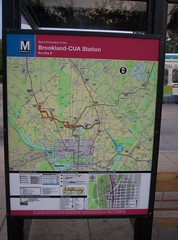
WMATA bus map, Brookland station, outside version
Become a part and parcel of the commuters' lives instead of a stand alone system and that is how you make money. There are enough examples in this country of how products become successful - take some lessons from corporate America.

I would welcome the comments / suggestions of the readers.

Labels: , ,

Saturday, April 07, 2007

Robert Cervero to speak about Tysons Corner

Robert Cervero is a professor at the University of California Berkeley and probably the most pubished researcher in the area of the connection between transportation and land-use. He'll be speaking Tuesday, April 17th, in Northern Virginia.
Flyer, Robert Cervero

Labels:

Tuesday, March 06, 2007

We need a transit users conference, now!

Cross-posted from Rebuilding Place in the Urban Space.

For more than a year, I've been suggesting that regional transit advocates need to have an annual conference, and lay out an "unconstrained" transit agenda, and then have the agenda "down" so that it can be pushed at any and every opportunity.

E.g. the Bethesda-New Carrollton Purple Line initiative is somewhat disconnected from the Cross-Wilson Bridge initiative from Branch Avenue to Alexandria. Wouldn't it make sense for these two initiatives to use the same technology?

A few weeks ago, I wrote about a transit users conference in Toronto, which brought about the power of "open source"--read civic engagement and deliberative democracy--to Toronto transit. See "Toronto "Transit Camp" engages citizens-users to improve the transit system."

DC1974 sends us a link to an article in SFist, "I wish," about ideas for upgrading and extending the Muni website and information services.

This reminds of the classic paper (later expanded into a book) by Eric Raymond, "The Cathedral and the Bazaar" about the difference between traditional and open source methods for creating computer software. This paper predates by many years the idea of Web 2.0 and community-software applications (such as Flickr, Myspace, Youtube), and user-generated content platforms.

The thing is, this is a paper about top-down vs. bottom-up initiatives generally. When I first read it, I was struck by the similarities about how his points on software development relate to civic engagement and democracy.

Another paper summarizes:

In his paper, Raymond discusses the historical model for software development and compares it to building cathedrals, a slow and laborious effort with exacting methods carefully applied. Each brick and beam was carefully planned and the structure was erected with painstaking craftsmanship to meet the planned design and symmetry.

The bazaar, by contrast, was often created ad-hoc and in an evolutionary fashion. The bazaar started with a few street vendors and was later built up by additional vendors and merchants, each staking out a piece of the market place as their own and maintaining and adding to their stall until a full-blown Agora was in place.

Clearly each approach served its purpose well, but the cathedral method is rigid and static. It needs the contribution of each part exactly as designed in order to stand, and has difficulty adapting to any other shape or location. The open-source movement is all about flexibility and evolutionary development.

Raymond went on to review nineteen axioms of open-source development by discussing his experience developing "Fetchmail," a Linux application used to forward e-mail. These axioms are the basic tenets of the open-source community, and Raymond discussed them with detailed analysis and examples in the original paper.

Open source isn't just about "flexibility and evolutionary development." It is also about the power and creativity of the group. Open source links skill to a kind of organized, somewhat ordered, but messy democracy.

"Getting There" is the Baltimore Sun's transit column, and yesterday's column, "Awareness the ticket for better bus use," has a similar suggestion, but about ensuring connectivity between systems. (Note that Cableflame, now a co-writer on the companion Dr. Transit blog, points out that the new WMATA subway maps show the bus links to Dulles (5A) and BWI (B30) Airports.)

Michael Dresser suggests a regionwide system connectivity conference, although he is more focused on the Baltimore region, and the Maryland Mass Transit Administration.

From the article:

To its credit, the Transit Riders Action Coalition is prodding the General Assembly to adopt connectivity among adjoining local systems as a basic principle of state transportation policy. The advocacy group is pointing to such anomalies as a Carroll County system that connects with no other transit systems. Then there's that issue of base realignment, bringing thousands of new jobs to an Aberdeen area with woeful connections to Wilmington, Del., and Philadelphia.

The MTA could jump to the head of this parade. Here's a modest suggestion for you:

Convene a "Connectivity Summit" this summer, inviting every regional and local transit agency between Philadelphia and Northern Virginia along with transit activists, disability-rights groups and anyone who wants to participate. Hash out all the issues - from a common fare structure, to a universal "smart card" to a unified schedule database.

The long-neglected local transit systems are eager to join in and are looking forward to working with you."We're all hoping that with the new administration, things are going to get much better," said Carl Balser, chief of transportation planning for Howard Transit. "We have been fairly marginalized in the transit community for the last several years and we're hoping for a renaissance."

Note that MTA doesn't have a ride guide comparable to that created and continually improved by WMATA. I have argued that WMATA should license this system to MTA for the Baltimore region. Afterall, MTA is a funder of the WMATA system.

Anyway, I say we need to go beyond a strict conference on connectivity, and have a true regionwide transit users and advocacy conference, in part along the Toronto model, promoting the idea of the power of the group and "open source" transit and;

2. That this conference be co-sponsored by the Baltimore Sun and the Washington Post, which runs the Dr. Gridlock column, as well as the Baltimore and Washington editions of the Examiner, which each run the "Sprawl and Crawl" column by Steve Eldridge.
cover_home
Note that along these lines, in January 2005, the Philadelphia City Paper did a great cover story on 33 ways to improve SEPTA. See "Let's Go." 33 ways to reinvent, rethink and recharge our beleaguered transit agency. Other cities around the world have cool public transportation systems. Why can't we?

Wouldn't it be cool for the Washington City Paper and the Baltimore City Paper to do this for each respective region, but run the articles the same week?

(Note that Mark Jenkins' piece in the Washington City Paper more than 10 years ago, proposing a Purple Line, was a significant contributor to my eventual involvement in these kinds of issues.)

Labels: , , ,